
Strategic planning is the backbone of any successful organization, and the right tools can significantly impact its effectiveness. This guide delves into the world of strategic planning tools, exploring various types, methodologies, and implementation strategies. From software solutions to established frameworks, we’ll examine how these resources facilitate informed decision-making, resource allocation, and ultimately, the achievement of organizational goals.
We’ll also consider the visual representation of strategic plans and the crucial role of key performance indicators (KPIs) in monitoring progress and ensuring accountability.
We will analyze the strengths and weaknesses of popular tools, offering a comparative perspective to aid in informed selection. Furthermore, we will cover the critical steps involved in implementing these tools, emphasizing best practices for data management and team collaboration to maximize their impact and ensure a smooth integration within existing organizational workflows. The journey to effective strategic planning involves careful consideration of various factors and methodologies, and this guide aims to illuminate the path towards successful implementation.
Strategic Planning and its Outcomes
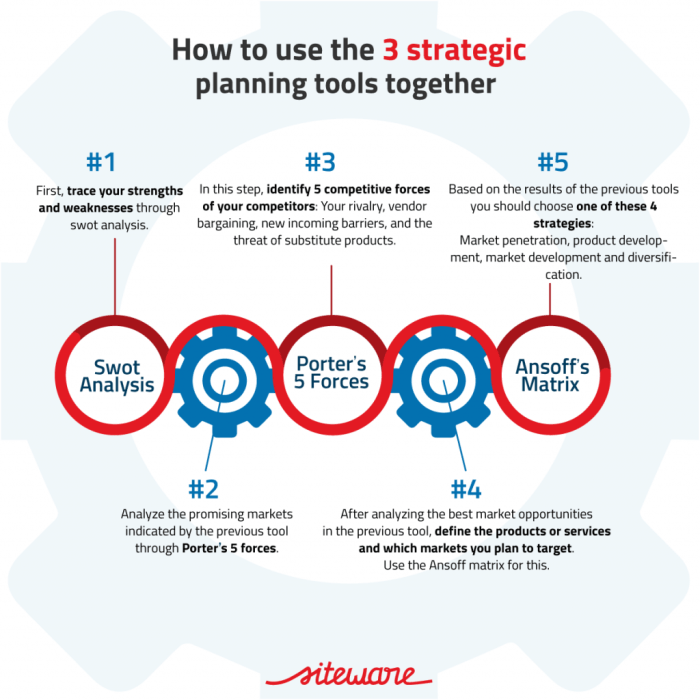
Strategic planning, when effectively implemented using appropriate tools, significantly enhances organizational performance. It provides a roadmap for achieving long-term goals, fostering better resource allocation, and improving overall efficiency. The impact is multifaceted, influencing everything from profitability and market share to employee engagement and innovation.Strategic planning tools facilitate a structured approach to defining objectives, analyzing the competitive landscape, and identifying opportunities for growth.
This structured process minimizes uncertainty and allows organizations to proactively adapt to changing market conditions. The resulting clarity of vision and purpose helps align all organizational efforts towards a common goal, leading to improved coordination and synergy.
Impact of Strategic Planning Tools on Organizational Performance
The positive impact of strategic planning tools on organizational performance is demonstrably linked to improved decision-making, enhanced resource allocation, and increased accountability. Organizations employing robust strategic planning processes often experience higher profitability, increased market share, and improved operational efficiency. This improved performance is often reflected in higher employee morale and a stronger organizational culture, fostering innovation and adaptability.
For example, a company using a balanced scorecard approach might identify key performance indicators (KPIs) that directly correlate with improved customer satisfaction and employee retention, leading to measurable improvements in those areas.
Case Studies Illustrating Successful Strategic Planning Tool Implementation
One successful case study involves a mid-sized manufacturing company that implemented a SWOT analysis (Strengths, Weaknesses, Opportunities, Threats) to identify its competitive advantages and potential challenges. By systematically analyzing its internal capabilities and the external environment, the company identified a niche market opportunity and reallocated resources to develop a new product line. This strategic shift resulted in a significant increase in revenue and market share within two years.
The SWOT analysis provided a clear framework for decision-making, enabling the company to prioritize investments and allocate resources effectively. Another example could be a technology company that used scenario planning to anticipate potential disruptions in the market. By considering various future scenarios, the company developed contingency plans and proactively adapted its strategy, mitigating the risks associated with technological advancements and changing consumer preferences.
This foresight allowed them to maintain a competitive edge and avoid significant losses.
Challenges in Implementing Strategic Planning Tools and Mitigation Strategies
Implementing strategic planning tools effectively can present several challenges. One common challenge is resistance to change from employees who are accustomed to traditional ways of working. Another is the difficulty in accurately forecasting future trends and market conditions, which can render strategic plans obsolete. Finally, insufficient resources, both human and financial, can hinder the successful implementation and execution of strategic plans.To mitigate these challenges, organizations should prioritize clear communication and employee involvement in the strategic planning process.
This fosters buy-in and reduces resistance to change. Regular monitoring and evaluation of the strategic plan are crucial to ensure its continued relevance and effectiveness. This allows for timely adjustments based on actual performance and evolving market conditions. Finally, securing sufficient resources and assigning dedicated personnel to manage the strategic planning process are essential for success.
By addressing these challenges proactively, organizations can significantly increase the likelihood of achieving the desired outcomes from their strategic planning initiatives.
Visualizing Strategic Plans
Effective visualization is crucial for understanding and communicating strategic plans. A well-designed visual representation can transform complex data into easily digestible information, fostering buy-in from stakeholders and enabling better decision-making. This section explores different visualization techniques for strategic plans and their applications.
Strategic Plan Visualization using a Mind Map
A mind map provides a visually appealing and intuitive way to represent a strategic plan. Imagine a central circle containing the overarching strategic goal, for example, “Increase Market Share by 20% in Three Years.” Branching out from this central idea are main strategic objectives, such as “Improve Product Quality,” “Expand into New Markets,” and “Enhance Marketing Efforts.” Each objective then further branches into specific tactics and action items.
For instance, “Improve Product Quality” might branch into “Invest in R&D,” “Implement Quality Control Measures,” and “Solicit Customer Feedback.” The use of color-coding, icons, and images can enhance clarity and memorability. This visual hierarchy clearly illustrates the relationship between the overall goal and the various steps required to achieve it.
Sample Dashboard Showing Key Performance Indicators (KPIs)
A strategic planning dashboard should display key performance indicators (KPIs) in a clear and concise manner. Consider a dashboard with four quadrants. The top left quadrant displays a bar chart showing “Market Share Growth” (percentage change compared to the previous year), color-coded green for growth and red for decline. The top right quadrant presents a line graph tracking “Customer Satisfaction” (measured via Net Promoter Score), highlighting trends over time.
The bottom left quadrant shows a pie chart illustrating the “Sales Revenue Breakdown” by product category, visually representing the contribution of each product to the overall revenue. Finally, the bottom right quadrant displays a number representing “Website Traffic” (unique visitors per month), indicating the effectiveness of marketing efforts. Each KPI is accompanied by a concise description and a target value, allowing for quick assessment of performance against strategic goals.
Enhancing Understanding and Communication through Visualization Techniques
Different visualization techniques cater to different needs and preferences. For instance, Gantt charts are effective for visualizing project timelines and dependencies, ensuring that tasks are completed on schedule. Network diagrams can illustrate the relationships between different departments or teams, highlighting potential bottlenecks and areas for collaboration. Heatmaps can effectively show the relative importance or performance of different aspects of the strategic plan, quickly identifying areas needing attention.
By selecting the appropriate visualization technique, organizations can ensure that their strategic plans are not only understood but also effectively communicated across all levels of the organization, leading to improved alignment and execution.
Strategic Planning
Strategic planning is the cornerstone of organizational success, providing a roadmap for achieving long-term goals. It’s a disciplined effort to produce fundamental decisions and actions that shape and guide what an organization is, what it does, and why it does it. Effective strategic planning ensures that resources are allocated efficiently, risks are mitigated, and opportunities are capitalized upon.
It’s not simply about creating a plan; it’s about fostering a culture of continuous improvement and adaptation.
Fundamental Principles of Strategic Planning
Several core principles underpin successful strategic planning. These principles guide the process and ensure the resulting plan is both effective and relevant. Understanding these principles is crucial for developing a robust and adaptable strategy. They include a clear definition of the organization’s mission, vision, and values; a thorough analysis of the internal and external environments; the setting of SMART (Specific, Measurable, Achievable, Relevant, and Time-bound) goals; and the development of action plans with clear responsibilities and timelines.
Furthermore, effective communication and regular monitoring and evaluation are essential to ensure the plan remains relevant and effective over time. A flexible approach, allowing for adjustments based on changing circumstances, is also vital.
Stages of a Comprehensive Strategic Planning Process
A comprehensive strategic planning process typically involves several key stages. These stages are iterative and often overlap, requiring continuous feedback and refinement. The process usually begins with a situational analysis, encompassing an assessment of the internal strengths and weaknesses, as well as external opportunities and threats (SWOT analysis). This is followed by defining the organization’s vision, mission, and values.
Next, strategic goals are established, followed by the development of specific action plans and resource allocation. Implementation, monitoring, and evaluation are crucial final steps, allowing for adjustments and refinements along the way. The entire process requires strong leadership and commitment from all stakeholders.
Different Approaches to Strategic Planning
Various approaches to strategic planning exist, each with its own strengths and weaknesses. For example, the top-down approach, where senior management dictates the strategic direction, offers clarity and efficiency but may lack buy-in from lower levels. In contrast, a bottom-up approach, involving participation from all levels, fosters greater engagement but can be time-consuming and less focused. Another approach, scenario planning, involves developing multiple potential future scenarios to prepare for various possibilities.
This approach is particularly useful in uncertain environments. Finally, the balanced scorecard approach integrates financial and non-financial metrics to provide a holistic view of performance. The choice of approach depends on factors such as organizational size, culture, and the nature of the industry. The selection of the most appropriate approach often requires a careful consideration of the specific circumstances and objectives of the organization.
Mastering strategic planning is a continuous process of refinement and adaptation. By understanding the diverse tools available and their appropriate applications, organizations can significantly enhance their ability to anticipate challenges, capitalize on opportunities, and achieve sustainable growth. The effective utilization of these tools, coupled with robust data management and collaborative team efforts, ultimately translates into improved organizational performance, increased efficiency, and a clearer path toward achieving long-term strategic objectives.
Remember that the selection and implementation of tools should be tailored to the specific needs and context of each organization, ensuring a customized approach that maximizes their impact.
FAQ Insights
What is the difference between strategic and operational planning?
Strategic planning focuses on long-term goals and overall direction, while operational planning details the specific steps to achieve those goals.
How often should strategic plans be reviewed and updated?
Ideally, strategic plans should be reviewed and updated annually, or more frequently if significant changes occur in the business environment.
What are some common pitfalls to avoid when implementing strategic planning tools?
Common pitfalls include inadequate data, lack of buy-in from stakeholders, and insufficient training on the chosen tools.
Can small businesses benefit from using strategic planning tools?
Absolutely! Even small businesses can benefit from using simplified strategic planning tools to define their goals and allocate resources effectively.


